
St. Charles Directory Holdings
The local shelf begins with two free digitized works and expands through physical Tri-City volumes, newspapers, census images, and archival files. Public catalog results confirm only selected annual volumes, so ask staff for the precise year instead of assuming a complete run.
| Collection | Years | Where held | Access |
|---|---|---|---|
| Ferslew Kane County directory | 1857 | Illinois Digital Archive | Free images and OCR; St. Charles pages 178–192 |
| J.F. Wilcox Biographical Directory and Census Report | 1885 | Illinois Digital Archive | Free digitized 160-page volume |
| Passing in Review | 1902–1904 | Illinois Digital Archive | Indexed newspaper reminiscences |
| Tri-City directory | 1910–present reported; 1910–11, 1912–13, 1943 confirmed | St. Charles and Batavia library collections | In-library reference; verify exact year |
| Historical newspapers | 1842–1998 reported | St. Charles Public Library archive | Searchable local microfilm |
| Kane census microfilm | 1840–1930 selected years | Batavia Local History Room | In-library microfilm |
The public catalog also shows a St. Charles, Illinois city directory under a local-history reference call number, but not its full run. No official source confirmed a separate reverse or criss-cross title. That is a question for the physical shelf and library staff.
The 1857 St. Charles Directory
Ferslew's Kane County gazetteer, directory, and business advertiser is the earliest directly inspected local directory. The St. Charles section sits inside a compound digital object. Its metadata warns that some numbered pages appear between local sections and blank pages were omitted. Browse the compound-page list rather than trusting a simple page-number jump.
A single page places laborers, a harness maker, farmer, painter, carpenter, nurseryman, watchmaker, lawyer and county judge, and a hotel boarder into one street grid. That variety makes the volume useful for family history and business history. It also shows why occupation and business affiliation can separate two people with similar names.
The scans were digitized in 2002 from material tied to the Everett D. Graff Collection and Newberry Library provenance. The archive describes high-resolution bitonal imaging, OCR work, and JPEG derivatives. Always compare OCR to the page image because initials and street abbreviations can be misread.
Read St. Charles Directory Entries
A city directory entry is compact. Copy it exactly before expanding the shorthand. Do not add a spouse, owner status, or modern street number unless the printed line actually supports it.
| Name | Surname and given name or initials; capitals may add emphasis |
|---|---|
| Occupation | Trade such as laborer, painter, carpenter, or lawyer |
| Business affiliation | An “of” phrase may identify a firm |
| Address | Street, corner, or between-streets description |
| Residence clue | “h” means home; “bds” means boards or lodges |
| Index order | Alphabetical surname sequence, with ads interspersed |
- Criss-cross directory
- A later directory section ordered by street and address. A specific St. Charles run remains unconfirmed.
- Householder index
- An address-oriented list of household heads, when a publisher includes one.
- Abbreviation key
- The volume's own list of shortened terms. In 1857, “bt” means between, “cor” corner, and “e of” east of.
The historical grid uses corners and blocks rather than standard postal form. “Main bt 1st and 2nd” and “Cedar bt 7th and 8th” should be mapped to the old town before being compared with modern parcel records.
St. Charles Residents in 1885
The 1885 St. Charles Biographical Directory and Census Report by J.F. Wilcox is broader than a name-and-address list. Its metadata describes a personal and family record of every city resident, along with local history, a classified and tabulated census, and public-officer material. Treat that claim as the volume's scope, then check each printed entry.
Open the 1885 directory in the Illinois Digital Archive before viewing the captured page.
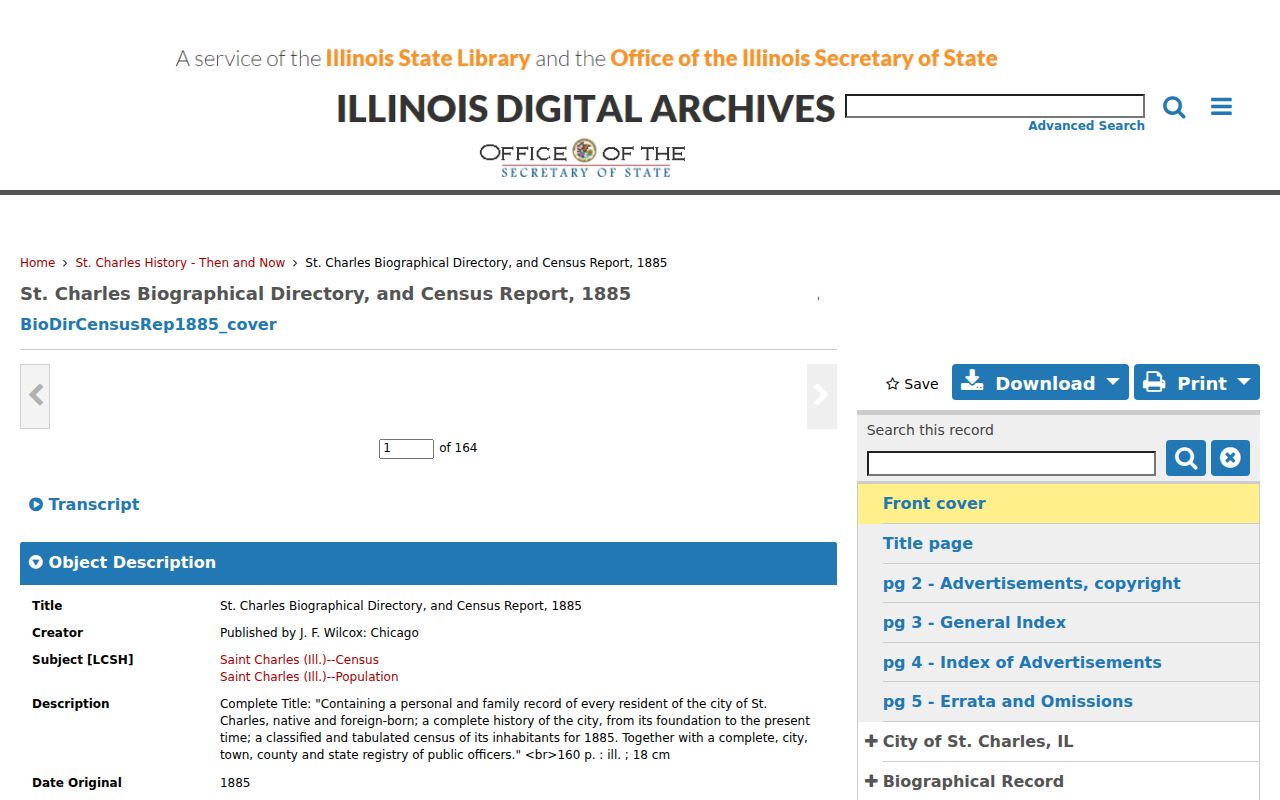
The image shows the archived book interface and its value as a page-level source. Save a stable item or page reference with each name. The book supplies context that a later phone-style listing may omit, but it remains a historical publication rather than proof of a current fact.
St. Charles Library History Shelves
The St. Charles Public Library history gateway leads to directories, newspapers, building files, maps, museum resources, and digital collections. Local-history books and vertical files cover families, biography, businesses, industry, and historic buildings. Some material is on the ground floor or in the Carnegie Quiet Room, while databases may require a card or in-building use.
Review the library's St. Charles history gateway alongside the saved image.
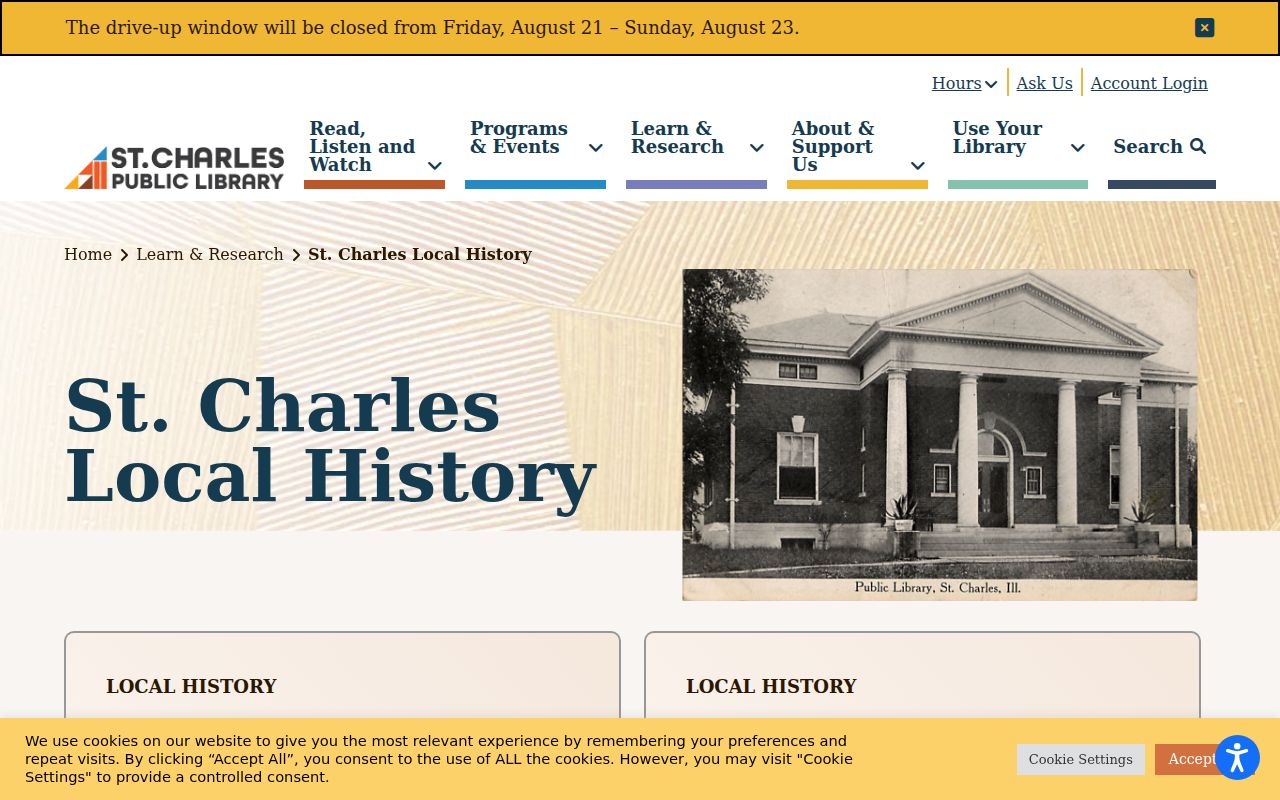
The gateway explains why a city directory search often continues offline. The library's 1989 reuse of the Carnegie building for genealogy and local history helped preserve books, vertical files, and microfilm even as digital access expanded.
Note: Ask for the exact directory title and year; “1910–present” describes collection scope, not proof that every annual volume is present.
St. Charles Genealogy Companions
Directories work best beside other dated sources. The library's genealogy resources include census, military, obituary, newspaper, map, archive, and society links. FamilySearch Affiliate access in the building can reveal images unavailable through an ordinary home account.
See the library genealogy resources represented in this capture.
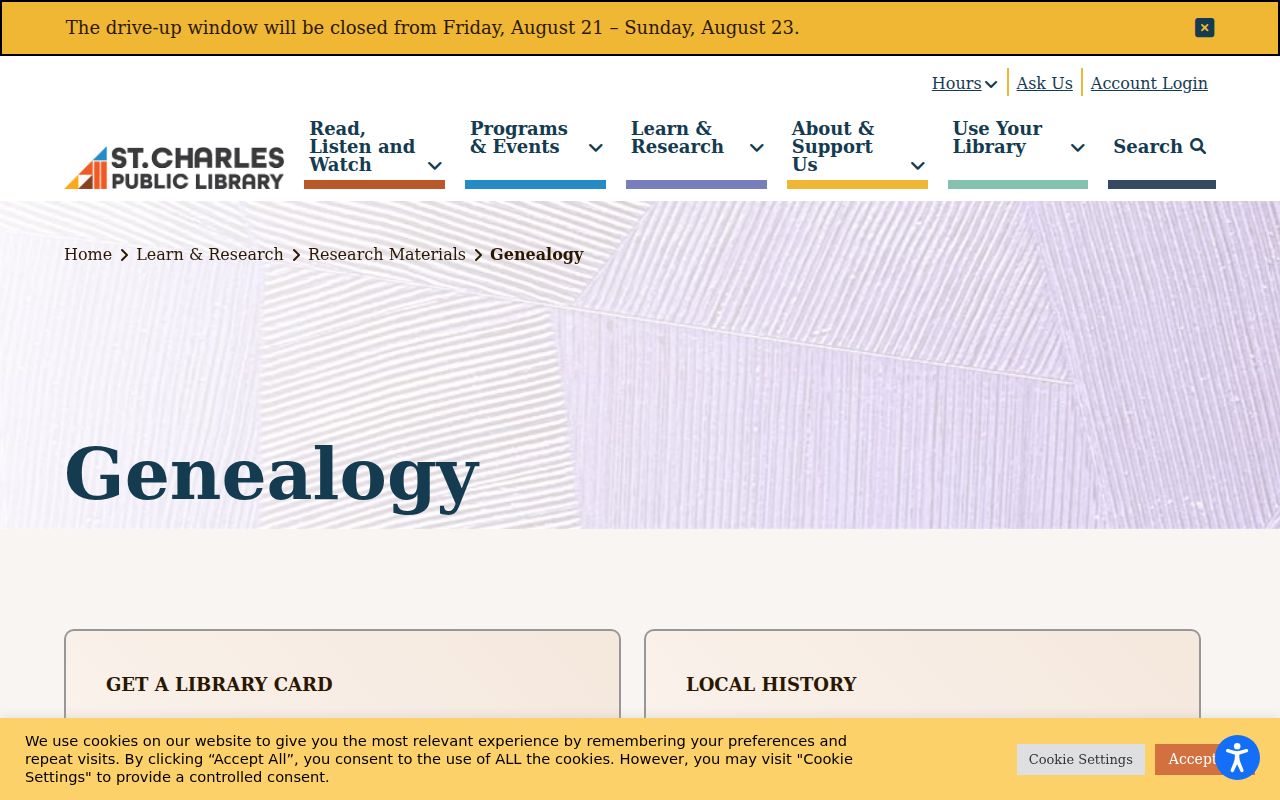
The image identifies the library as an access point, not the owner of every linked record. A census can add household composition and birthplace. The newspaper archive can add an obituary, marriage notice, business item, or address change. Each clue should retain its own date and source.
Trace Families in St. Charles Directories
Following one household across city directories can fill years between federal censuses. The 72-year federal release rule means released census images now extend through 1950, while library database descriptions cite older image sets through 1940. Use the closest available census without assuming that a directory household and census household are identical.
- Start with a verified surname, business, or address in one volume. Copy spelling, trade, lodging marks, and the exact street phrase.
- Check the preceding and following directory years. Record moves, new occupations, name variants, and gaps without guessing why a person disappears.
- Pair the directory year with the nearest released census to compare ages, birthplaces, relationships, and household members.
- Search the 1842–1998 local newspaper archive for notices, obituaries, civic activity, and business changes.
- Move a property question to the Recorder, or a modern address question to the St. Charles street directory search.
A missing entry can mean death, a move, publication gaps, an unlisted household, a changed surname, or OCR failure. It is not proof of any one outcome. Search nearby years, then seek a newspaper, census, deed, or probate source.
St. Charles Museum Research
The St. Charles History Museum, founded in 1933, reports more than 10,000 photographs and 15,000 artifacts. Its CatalogIt presence and appointment route can add a building photograph, family item, business image, or institutional file that does not appear in a directory.
Visit the museum's collection and research site before using the saved view.
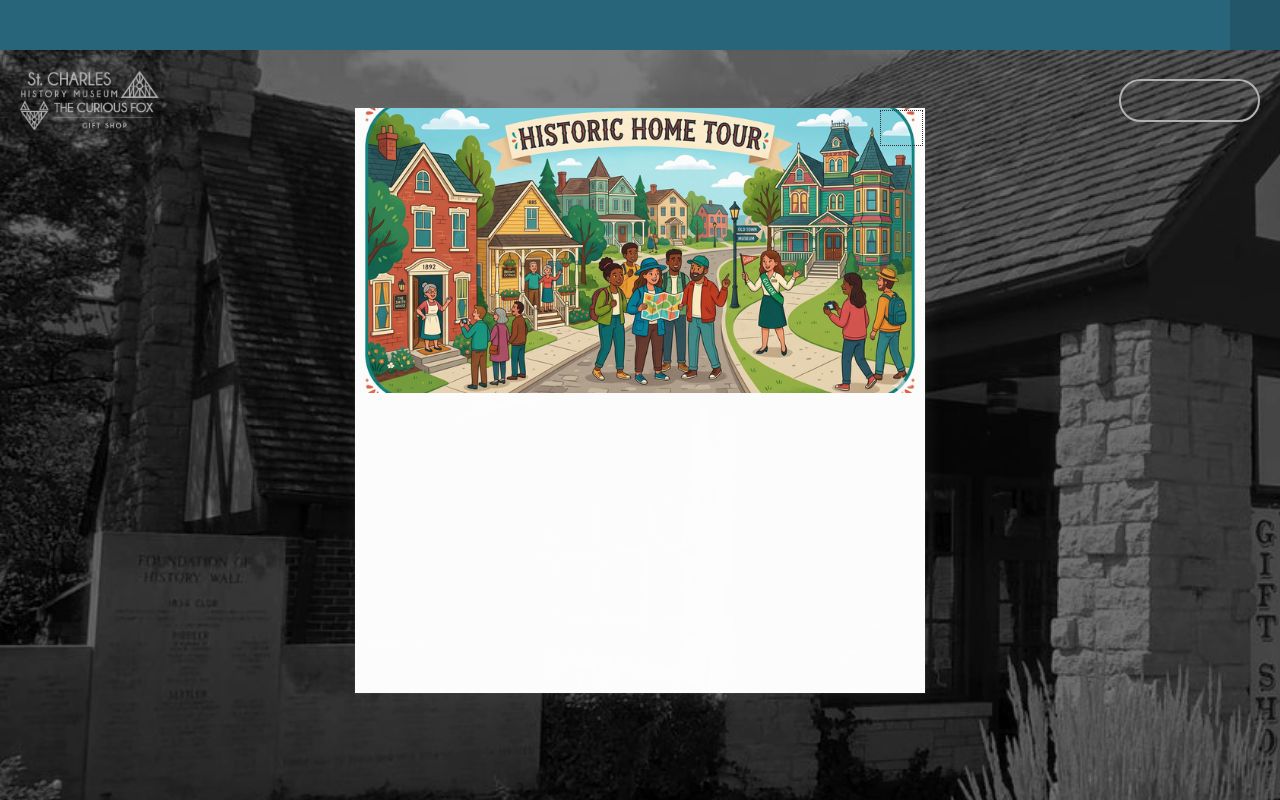
The image points to a staffed research channel. Send a focused request with the full name, spelling variants, street, date range, and directory citation. An appointment may be needed for collection access.
St. Charles Buildings and Directories
Historic building sources can connect an old city directory address to a present site. The city's Central survey covers 380 structures and sites. Moody-Millington covers 17 properties, Millington covers 51, and the Pottawatomie survey used 2022–23 fieldwork with a 2024 report, though the city says it is not a historic district.
Open the library's historic buildings research page shown in this capture.
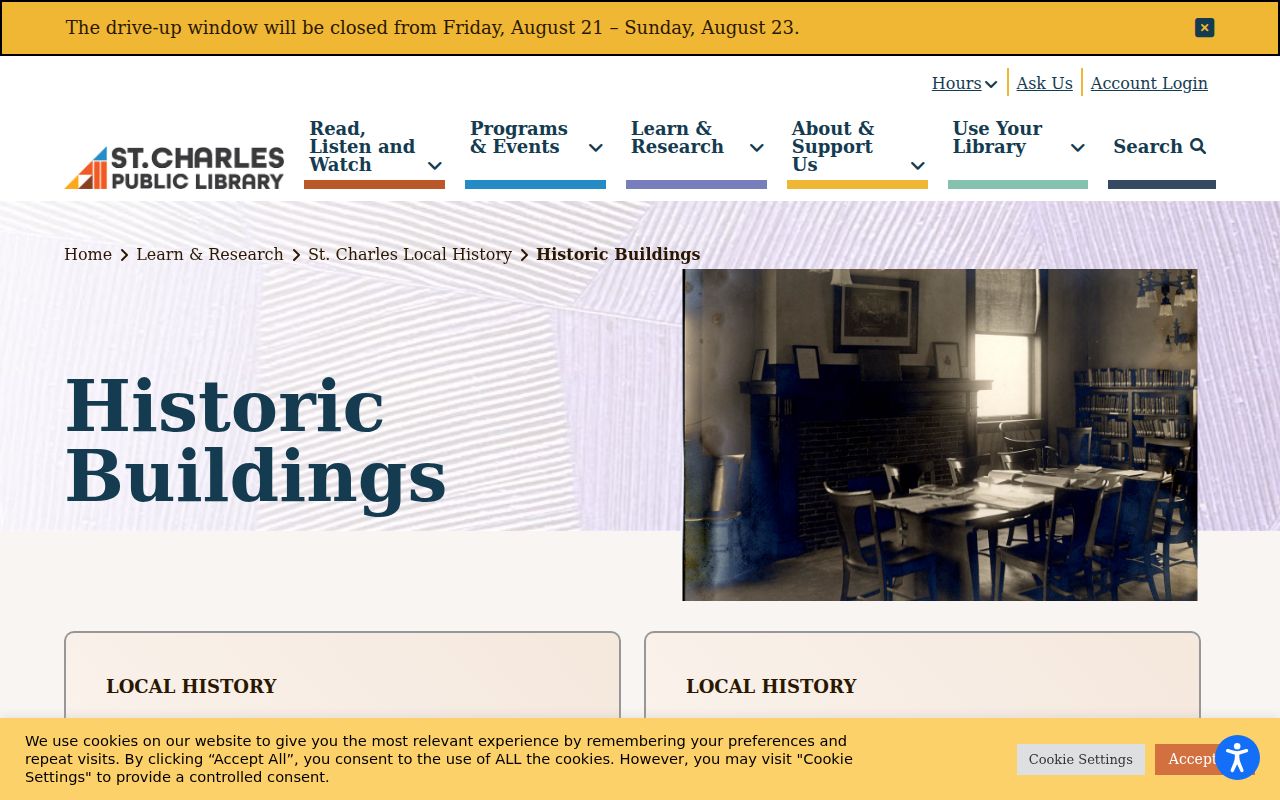
Building files, old newspapers, maps, and museum appointments help translate a corner or between-streets entry. They can document a structure or prior use without proving that every named owner lived there.
St. Charles Directory Timeline
The local record trail mixes printed directories, public archives, and later digital delivery. Its dated milestones explain why no one portal is complete.
| 1837 | Kane County land-record archive begins |
|---|---|
| 1857 | Ferslew directory supplies the earliest inspected St. Charles entries |
| 1885 | Wilcox publishes the biographical directory and census report |
| 1902–1904 | Passing in Review preserves named reminiscences |
| 1910 onward | Library reports the Tri-City directory era, with selected years confirmed |
| 2002 | Illinois Digital Archive metadata dates key St. Charles digitization |
The land-title track, printed directory track, and community-memory track overlap but do not duplicate each other. Cite the custodian and year for every finding, and compare OCR with the original image.